

Turn every finished job into a 5-star Google review, automatically.
The AI Review Filter asks every customer for feedback the moment a job wraps, helps happy customers post a polished Google review in seconds, and routes unhappy ones straight to your team before they go public. More reviews, higher ratings, better local rankings, all on autopilot.
Why reviews decide who wins the job
Reviews are the cheapest growth lever your customers have.
Before anyone calls a hauler, they read. Ratings, review count, recency, and how a business answers complaints all shape the decision in seconds. The data on this is not subtle.
of people read online reviews before picking a local business.
BrightLocal, 2026higher purchase likelihood once a listing shows around five reviews versus none.
Spiegel Research Center, Northwesternwill only use a business rated four stars or higher, up sharply year over year.
BrightLocal, 2026of businesses ever reply to their reviews, even though most customers expect it.
Upfirst, 2025How the AI Review Filter works
One link does the asking, the writing, and the sorting.
Your customer never has to think of what to write, and you never have to chase a review again. Here is the full flow.
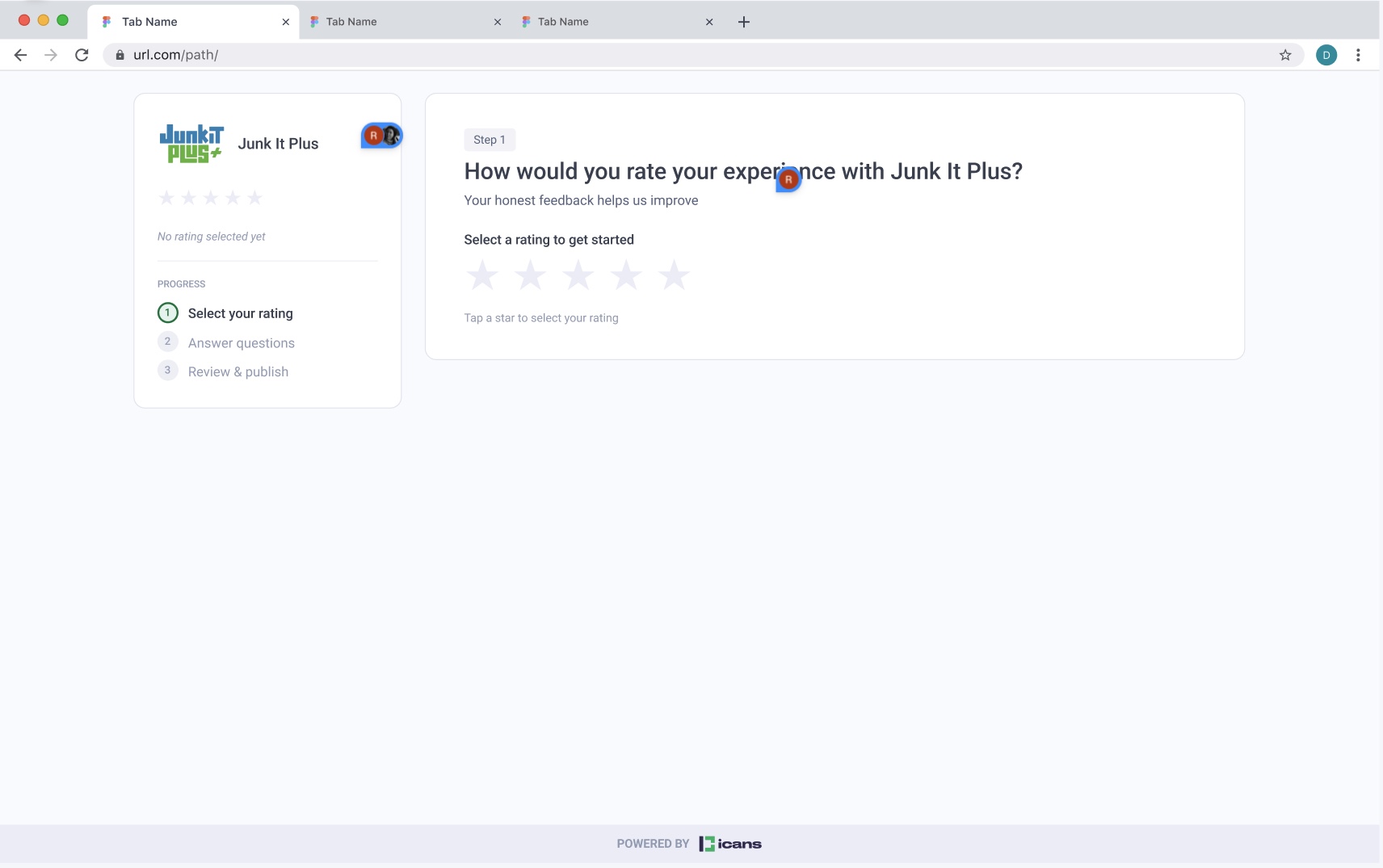
The request goes out the second a job is done
iCANS sends a branded review request by email or text right after the work order closes, while the experience is still fresh. No CSV exports, no manual sending, no forgetting. The link carries your logo, not ours.
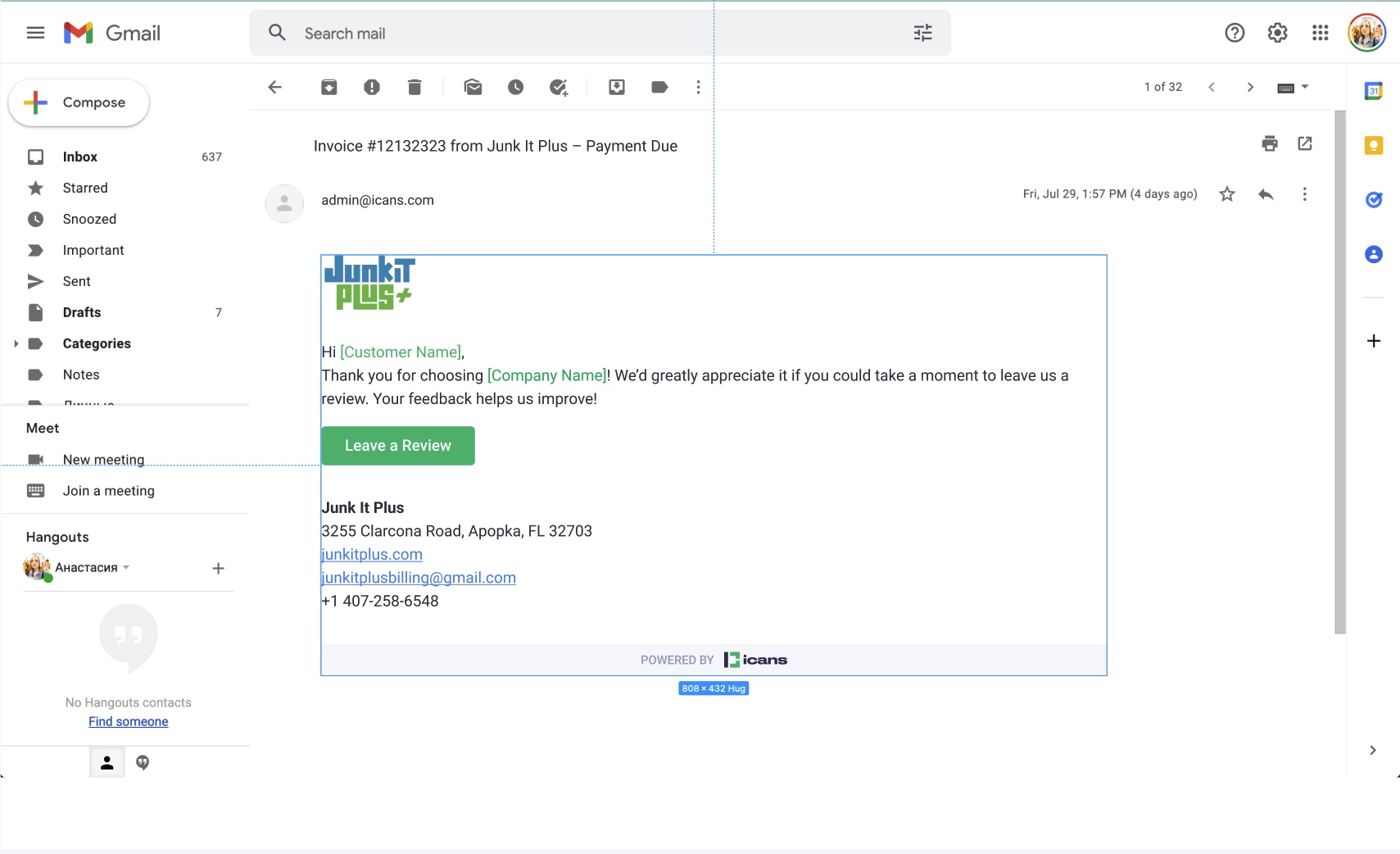
The customer rates the experience first
A single tap on a star sets the whole flow in motion. That rating decides what happens next: a smooth path to a public review for happy customers, or a private path straight to your team for anyone who is not satisfied.
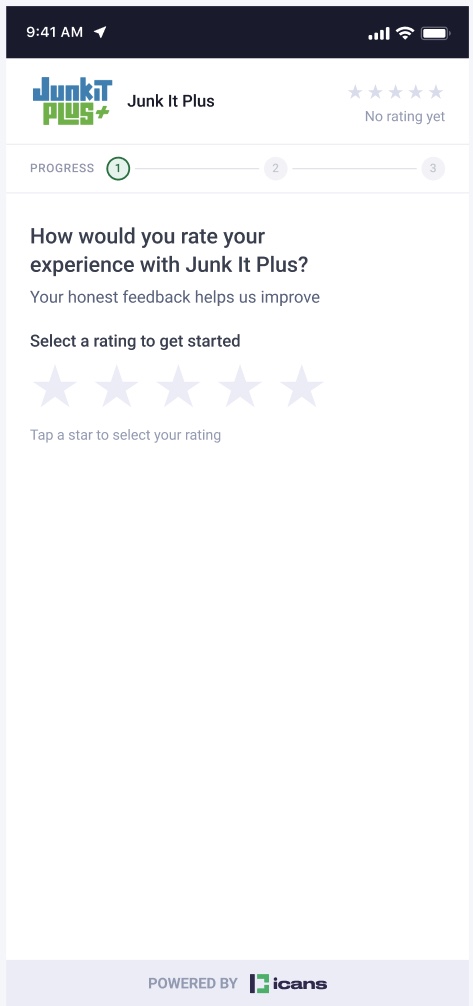
The rating sends them down the right path
Two outcomes, both useful. Public proof when people are happy, a private save when they are not.
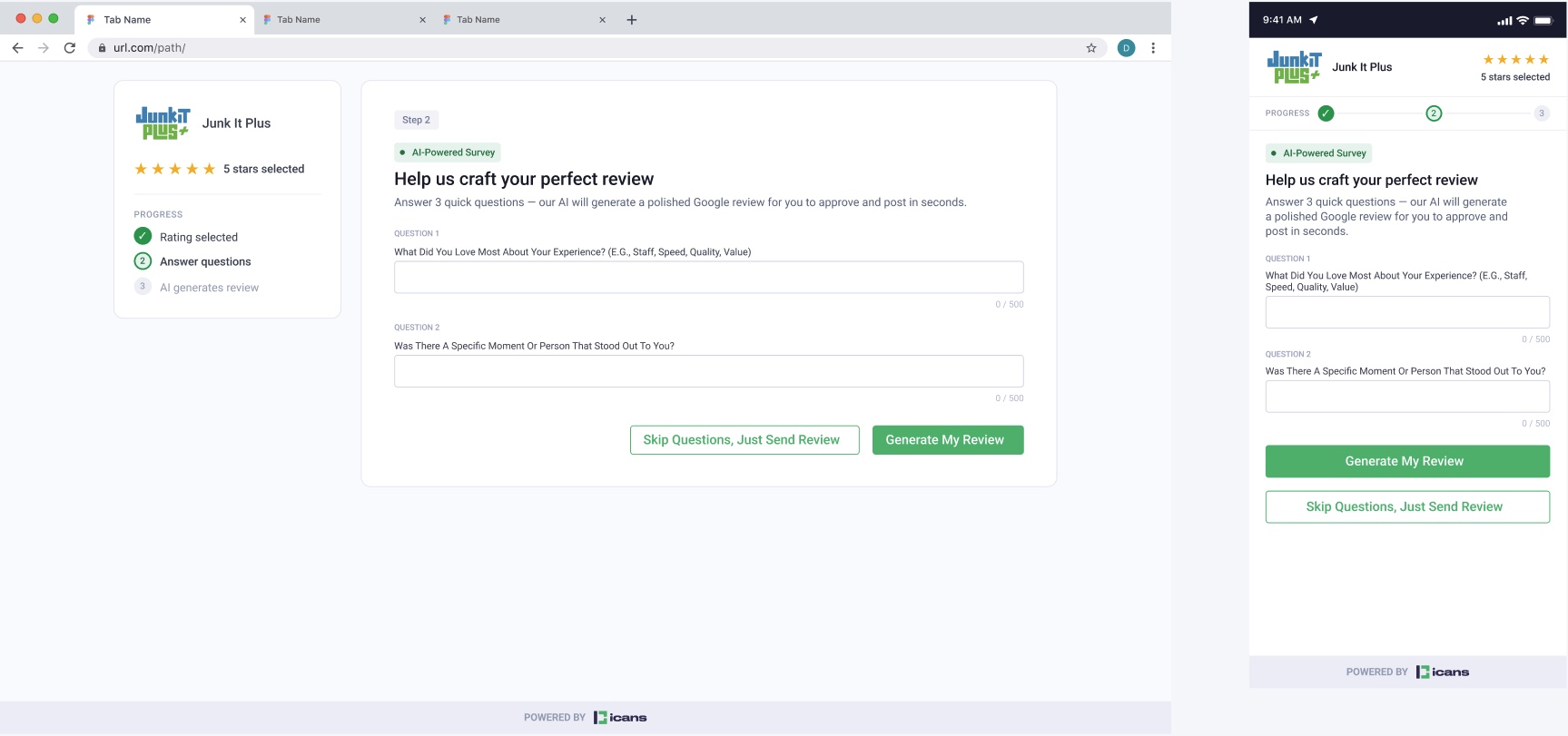
AI drafts the review from their own words
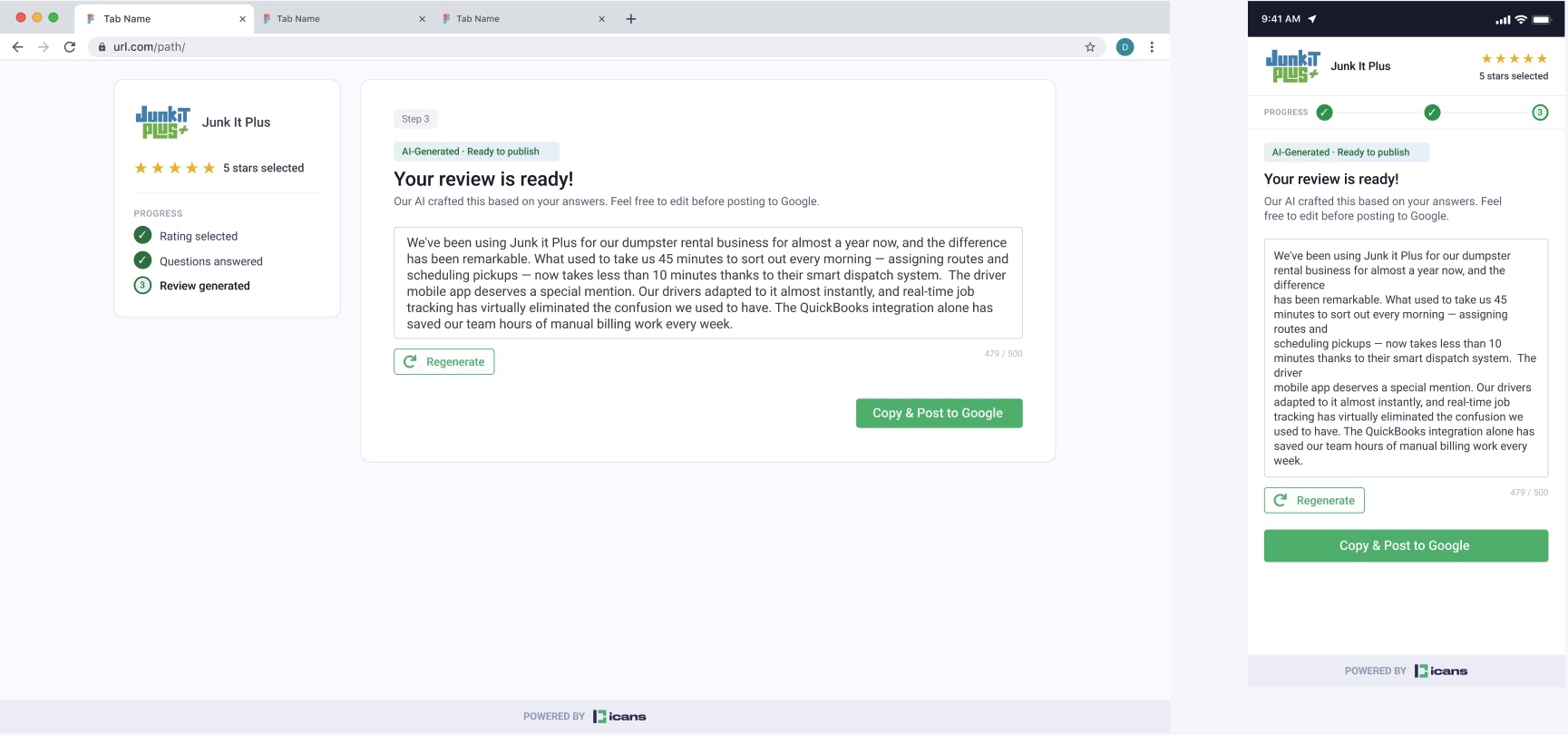
Three quick questions, and the AI turns the answers into a clear, natural Google review. The customer reads it, edits anything they want, and posts it under their own account in one tap. Their experience, their words, just without the blank-page friction that kills most reviews.
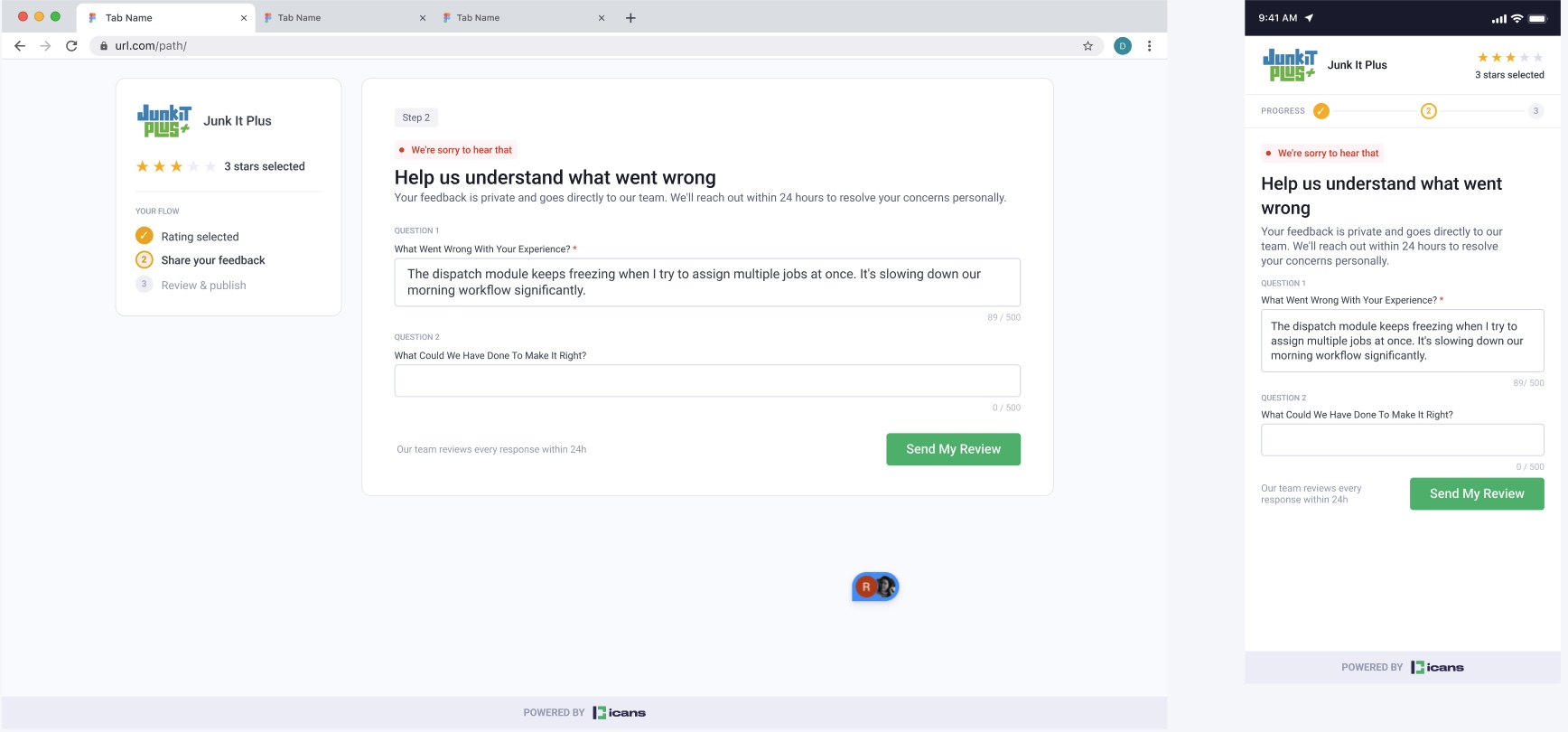
Unhappy customers reach your team first
A lower rating opens a private feedback form that lands with your team, not on a public profile. You get a real chance to fix the problem within hours, recover the customer, and stop a frustrated moment from becoming a permanent one-star. Nothing is hidden from the customer; they choose where their public review goes.
Approve and post to Google in seconds
The finished review sits ready with a one-tap “Copy and Post to Google” button. Most customers approve it as written. Because the words come from their own answers and they sign off before posting, the review stays authentic and specific, the kind Google and shoppers trust most.
Watch it all from one dashboard
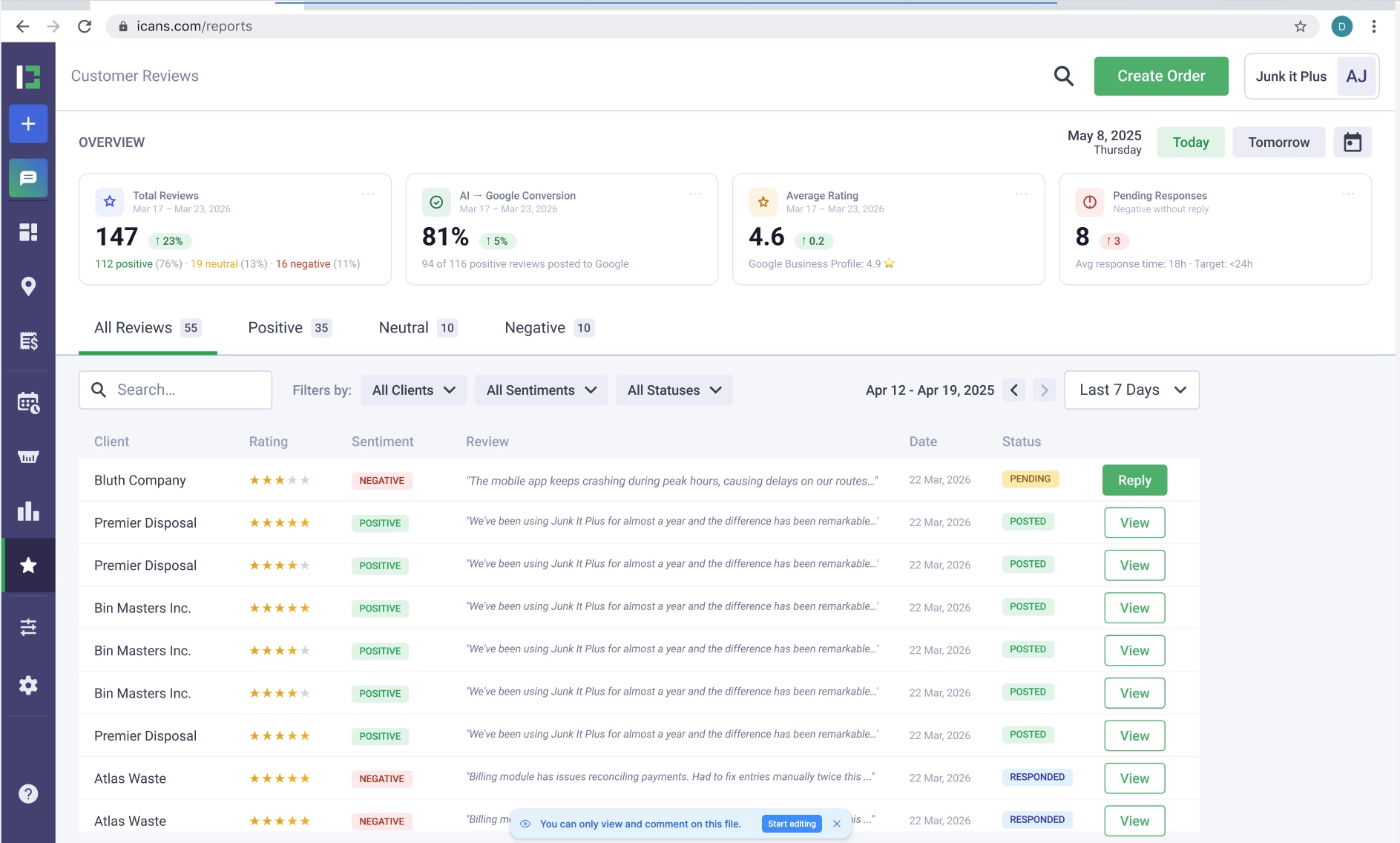
Every request, rating, sentiment, and posted review rolls up into the Customer Reviews dashboard. Track total reviews, your AI-to-Google conversion rate, average rating, and any negative feedback still waiting on a reply, across one location or fifty.
Reviews and organic rankings
More reviews is one of the few ranking levers you actually control.
Google does not show you a dial labeled “rank higher.” It shows you the Google Business Profile, and reviews are a documented input into how that profile ranks in the local map pack and local organic results. Most ranking factors take months of links and content to move. Reviews can shift in weeks.
In the most recent local search ranking research, review signals climbed to roughly a fifth of what drives local pack rankings, up from about 16% a couple of years earlier. The businesses that win competitive categories tend to share the same profile: more reviews, higher ratings, and a steady, recent stream rather than a stale pile.
- Volume. Total review count signals prominence. In most local markets, 50 to 100 recent reviews puts a business in a strong position.
- Velocity and recency. A consistent flow of fresh reviews outperforms hundreds of old ones. Many shoppers ignore anything older than a month.
- Rating. Higher average ratings lift both ranking and click-through, and the trust range sits around 4.2 to 4.7 stars.
- Keywords in reviews. Google reads review text. Reviews that mention the service and the city add relevance for those terms.
- Owner responses. Replying signals an active, trusted profile and is itself a ranking and trust input.
The map pack premium
more traffic for businesses in the local 3-pack versus positions four through ten, and around 93% more customer actions.
Sources: Whitespark / BrightLocal local search ranking studies; SocialPilot; LocaliQ.
Reviews and the buying decision
Ratings move money, and the research has the receipts.
This is not a soft “good to have.” The link between reviews and revenue has been measured in controlled studies for over a decade.
conversion lift, on average, once a page displays reviews versus none. The first five reviews drive most of it.
Spiegel Research Centerhigher purchase likelihood when a review carries a verified-buyer signal versus an anonymous one.
Spiegel Research Centeris the star range that converts best. A flawless 5.0 can read as too good to be true.
Spiegel Research CenterWhy “perfect” is not the goal. Buyers want realism, not a wall of identical five-star praise. A 4.2 to 4.7 average with detailed, recent, customer-written reviews builds more trust than a suspiciously spotless profile. The AI Review Filter is built around exactly that: real experiences, in the customer’s own words, approved before they post.
The negative reviews everyone reads
Shoppers go looking for the bad reviews on purpose.
Here is the part most businesses miss. People do not just skim the praise. They hunt for the worst-case scenario before they spend a dollar. Around 96% of review readers specifically seek out negative reviews, and the majority say they read the business’s reply before deciding whether to buy. A complaint with a calm, helpful owner response often builds more trust than no complaints at all.
That is why ignoring a one-star is the expensive move, not the safe one. The reply is not for the angry customer. It is for the next hundred prospects reading over their shoulder.
How to respond to a negative review
A simple framework your team can run every time. Keep it short, human, and forward-looking.
Respond fast
Aim for 24 to 48 hours. Most customers expect a reply to a negative review within a week, and speed signals you care.
Stay calm and professional
Never get defensive or argue the facts in public. Tone is read by everyone who lands on the profile later.
Acknowledge the specific issue
Name what went wrong and apologize for it plainly. Generic copy-paste replies read as exactly that.
Take it offline
Offer a direct contact to make it right. It moves the heat off the public thread and into a real fix.
Show what changed
If you fixed the root cause, say so. Future readers want proof you act on feedback, not just apologize for it.
Keep it brief and personal
Use the customer’s name, a couple of sentences, and a clear next step. Long defensive walls of text backfire.
What the data says about bad reviews
- 96% of review readers specifically look for negative reviews.
- 70%+ check how a brand responds to complaints before buying.
- 94% have avoided a business because of its negative reviews.
- 4 to 5x longer is how much time shoppers spend on a site when they engage with negative reviews, often with higher intent to buy.
The recovery path does the heavy lifting here. By routing unhappy customers to your team before they post, the AI Review Filter buys you the 24-hour window to fix the problem in private. Resolve it, and many of those customers never post the one-star at all. The ones who still do, you have already answered.
What you get
Everything the AI Review Filter handles for you.
Automatic requests
Email and text requests fire the moment a work order closes, fully branded to your client. No manual sending, ever.
AI review drafting
Turns three quick answers into a clear, specific Google review the customer edits and approves before posting.
Sentiment routing
High ratings head to Google, low ratings go private to your team, so you fix problems before they go public.
Response assist
Draft on-brand replies to both praise and complaints in seconds, so no review sits unanswered.
Reviews dashboard
Volume, sentiment, average rating, and AI-to-Google conversion, tracked across every location you manage.
Recovery alerts
Negative feedback flags your team instantly with a response-time target, so save attempts happen inside 24 hours.
Questions
AI Review Filter, answered.
Do reviews really affect my Google ranking?
How many reviews do I need to be competitive?
Are AI-drafted reviews authentic and allowed?
What happens when someone leaves a low rating?
Should I respond to negative reviews?
Does it work across multiple locations or clients?
Start collecting better reviews this week.
Put the AI Review Filter to work after every job and watch your rating, review count, and local visibility climb, while your team finally gets ahead of the unhappy ones.
No credit card to start · Set up in minutes